Research Overview
Theoretical Condensed Matter • Quantum Materials • Photonics • Transport Phenomena
My research investigates the fundamental physics of electrons, photons, and phonons in low-dimensional and topological quantum materials. By developing theoretical and numerical models based on quantum field theory, kinetic Boltzmann transport, and quantum geometry, my group explores non-classical driving forces in solids. Below is an overview of my core past and ongoing research topics, followed by our future research vision.
Raman Spectroscopy of Nanocarbons & Two-Dimensional Materials
Raman spectroscopy is an essential probe for electron-photon and electron-phonon interactions. In metallic single-wall carbon nanotubes (SWNTs) and graphene, experiments uncovered unconventional Raman signals that deviate from standard phonon scattering. We developed comprehensive theoretical models incorporating electronic band structures, electron-photon coupling, electron-phonon self-energy, and Coulomb interactions to unravel these phenomena:
- Electronic Raman Scattering (ERS): Explained the asymmetric Breit-Wigner-Fano (BWF) lineshapes and resonant electronic Raman peaks in metallic SWNTs.
- Kohn Anomalies & Quantum Interference: Calculated phonon self-energies in gate-modulated graphene, showing how Fermi energy tuning modifies the real (frequency shift) and imaginary (linewidth/lifetime) parts of phonon modes.
- Lifshitz Transition & Screening: Probed heavily Cs-doped epitaxial graphene on Ir(111) via angle-resolved photoemission spectroscopy (ARPES) and Raman spectroscopy.
- Anisotropic Phonons in Black Phosphorus: Modeled polarization-dependent anisotropic electron-photon and electron-phonon interactions arising from the buckled puckered honeycomb lattice.
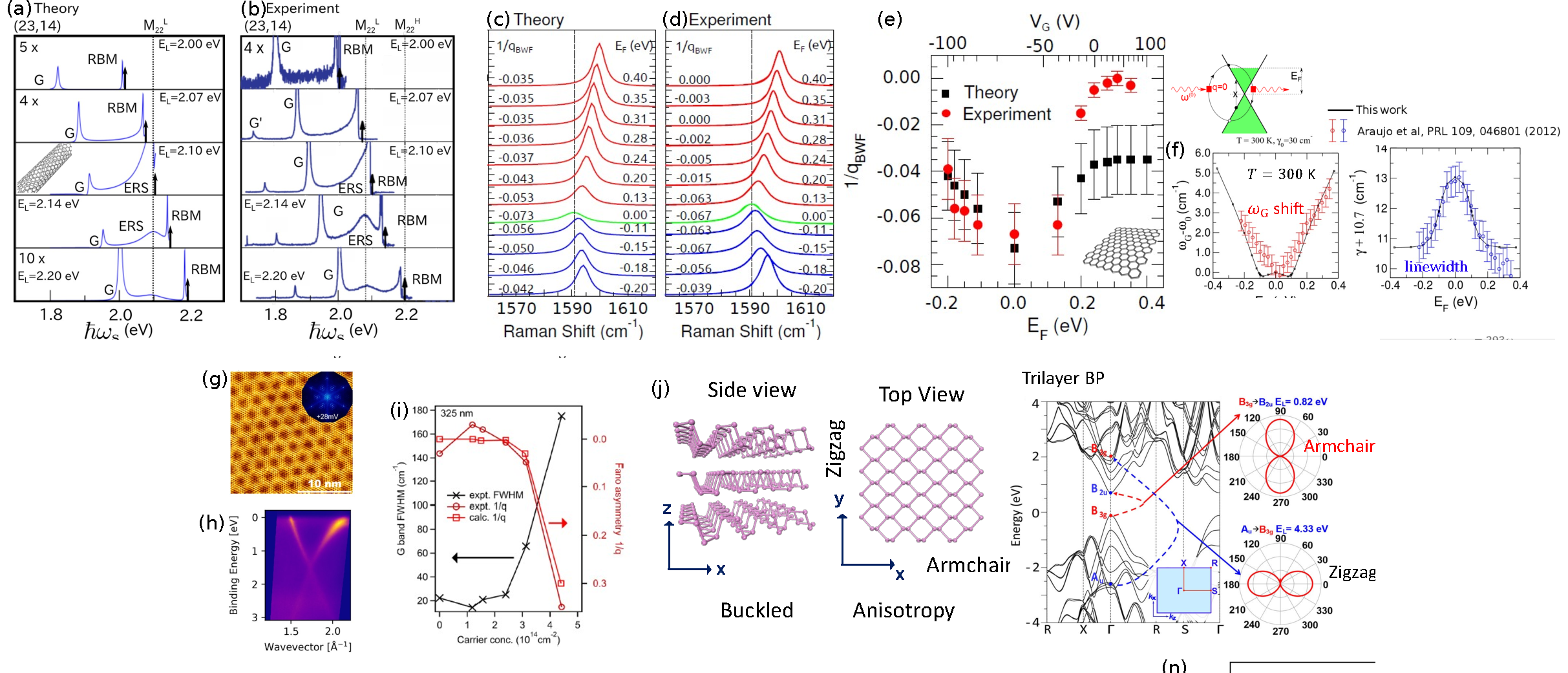
Figure 1: Raman and Phonon Spectroscopy Overview. (a–b) Theoretical and experimental electronic Raman spectra (ERS) in metallic SWNTs showing resonant $M_{22}^L$ transitions and Fano asymmetry [Phys. Rev. B 88, 115107 (2013)]. (c–f) Gate-dependent Raman spectra and Kohn anomaly in graphene, capturing Breit-Wigner-Fano asymmetry and phonon self-energy [Phys. Rev. B 90, 245140 (2014); Phys. Rev. B 94, 075104 (2016)]. (g–i) Scanning electron microscopy, ARPES, and Raman spectra of Cs-doped graphene on Ir(111) across the Lifshitz transition [Nano Lett. 18, 6045 (2018)]. (j) Anisotropic Raman and optical response in puckered black phosphorus [Nano Lett. 16, 2260 (2016)].
Thermoelectric Transport in Low-Dimensional Materials
Thermoelectrics enable direct solid-state conversion between thermal gradients and electrical power. Inspired by Hicks and Dresselhaus' pioneering predictions, we investigated how low dimensionality, band engineering, and quantum confinement dramatically enhance thermoelectric performance:
- Universal Quantum Confinement Rule: Demonstrated that thermoelectric power factor enhancement occurs universally when the confinement length $L$ is smaller than the thermal de Broglie wavelength $\Lambda$ ($L / \Lambda < 1$).
- Diameter-Dependent Seebeck Effect: Uncovered the Seebeck coefficient scaling in semiconducting carbon nanotubes and its direct connection to diameter-dependent bandgaps.
- Band Engineering & Optimal Bandgap: Analyzed optimal bandgaps and Mexican-hat dispersion profiles for maximizing the thermoelectric figure of merit ($ZT_{\max}$) in 2D Dirac materials and transition-metal oxides like $\mathrm{CaMnO_3}$.
- Topological & Half-Metal Thermoelectrics: Identified spin-tunable thermoelectric transport in monolayer chromium pnictides and bismuthene, as well as optimal half-metal band structures for high-performance thermoelectricity (Phys. Rev. B 2024).
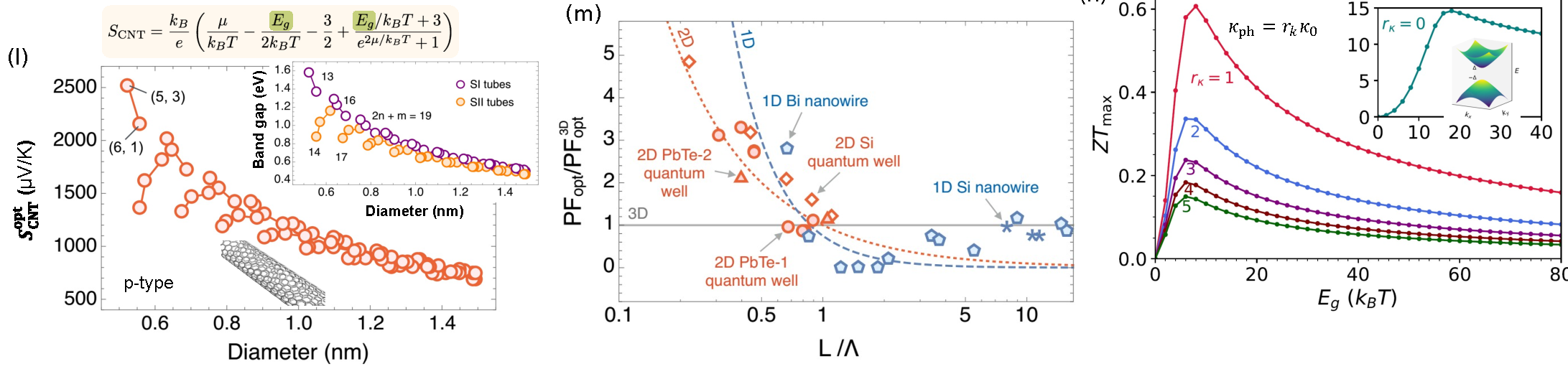
Figure 2: Thermoelectric Transport in Nanostructures. (l) Diameter dependence of Seebeck coefficient (thermopower) in semiconducting SWNTs compared with bandgap scaling [Phys. Rev. B 92, 165426 (2015)]. (m) Quantum enhancement of thermoelectric power factor in low-dimensional nanostructures governed by $L / \Lambda < 1$ [Phys. Rev. Lett. 117, 036602 (2016)]. (n) Maximum thermoelectric figure of merit $ZT_{\max}$ as a function of bandgap $E_g$ and phonon thermal conductivity ratio $r_\kappa$ [J. Appl. Phys. 126, 035109 (2019)].
Optoelectronics of Quantum Materials & Wave Function Geometry
Quantum materials exhibit exotic optical and transport properties driven by the geometric phase of their Bloch wave functions. During my research at A*STAR Singapore and the University of Luxembourg, we explored how Berry curvature and topological boundary states unlock novel optoelectronic functionality:
- Cyclotron Motion Without Magnetic Fields: Showed that in anomalous Hall materials with broken time-reversal symmetry, non-zero Berry curvature induces transverse anomalous velocities that drive cyclotron-like electron trajectories. When excited by linearly polarized optical pulses, these systems emit circularly polarized radiation without any external $\mathbf{B}$-field.
- Topological Domain Wall Plasmons: Discovered that domain walls in gapped bilayer graphene host 1D chiral boundary modes supporting plasmons whose lifetimes exceed bulk transport scattering times by an order of magnitude, limited only by intervalley scattering.
- Faraday and Kerr Rotations in Flat Bands: Characterized polarization rotation in topological flat and dispersive band systems, opening avenues for optical detection of non-trivial topological invariants.
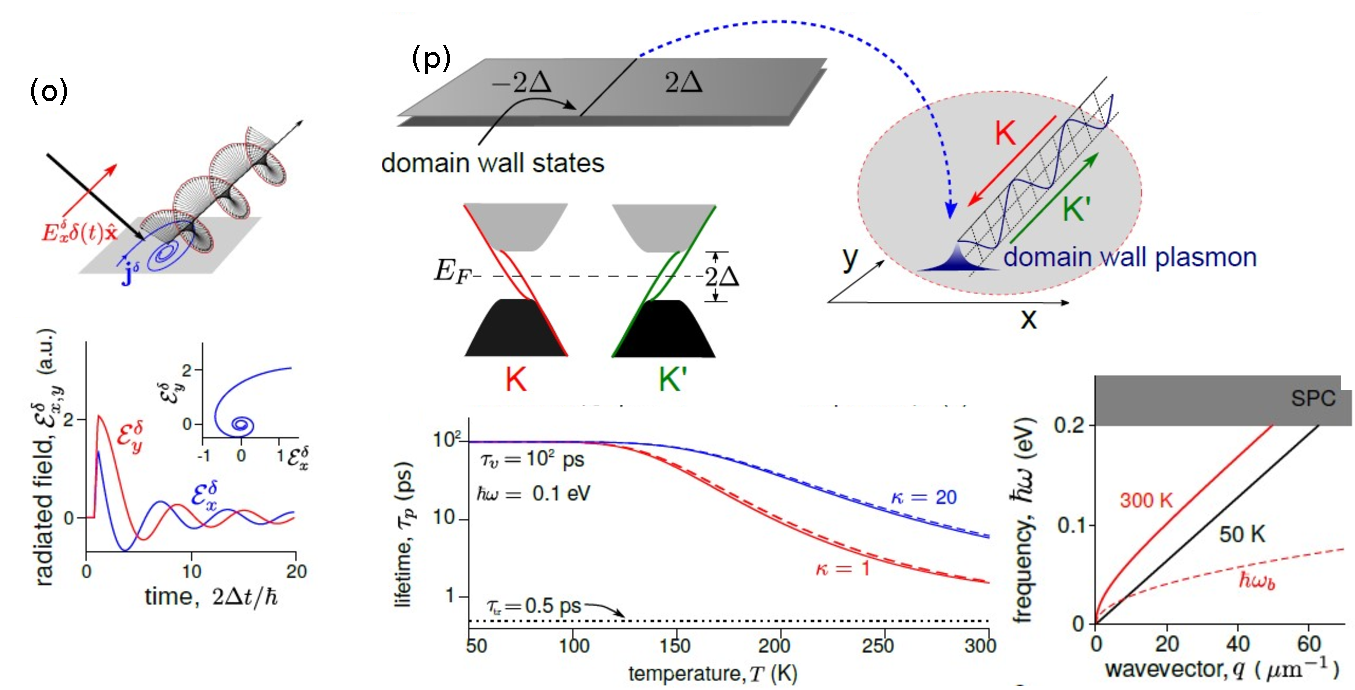
Figure 3: Geometric Optoelectronics and Edge Plasmons. (o) Cyclotron motion without magnetic field: An incident linearly polarized laser pulse $E_x^\delta(t)\hat{\mathbf{x}}$ drives a transverse cyclotron current that radiates circular polarization [New J. Phys. 21, 083026 (2019)]. (p) Topological domain-wall plasmons in inverted-gap bilayer graphene displaying long lifetimes transcending bulk limits [Nano Lett. 17, 7252 (2017)].
Hydrodynamic Transport of Viscous Electrons
In ultra-clean 2D systems such as encapsulated graphene, momentum-conserving electron-electron collisions dominate over impurity and phonon scattering. Under these conditions, the electron ensemble flows collectively like a viscous fluid described by the hydrodynamic Navier-Stokes equations:
- Quantum Geometric Navier-Stokes Equation: Derived the hydrodynamic equations of motion incorporating Berry curvature ($\boldsymbol{\mathcal{B}}$). This quantum correction generates anomalous Hall velocity, producing asymmetric 1D Poiseuille flows, boundary-free backflows (vortices) in 2D channels, and asymmetric non-local resistance.
- Interlayer Coulomb Drag & Negative Drag Conductivity: Discovered that in viscous electron-electron bilayers, momentum exchange between layers introduces a novel drag viscosity $\nu_d$. In narrow channels, this drag viscosity causes the passive layer current to reverse direction, generating negative drag conductivity.
- Rashba Spin-Orbit Coupling in Electron Fluids: Established hydrodynamic equations in 2D electron gases with spin-orbit coupling, clarifying how spin-split Fermi surfaces alter electron viscosity and transport coefficients.
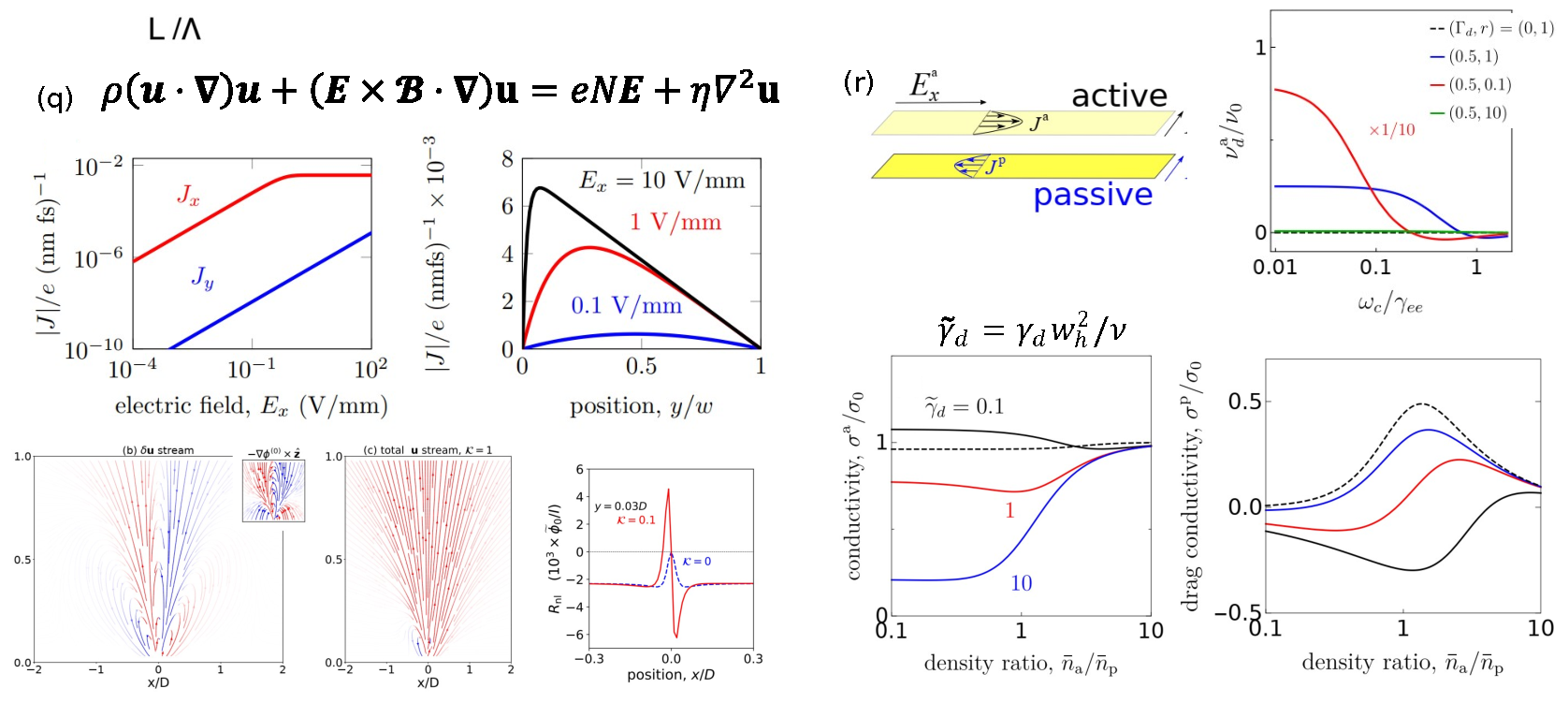
Figure 4: Quantum Hydrodynamic Flows and Coulomb Drag. (q) Quantum Navier-Stokes equation $\rho(\mathbf{u}\cdot\boldsymbol{\nabla})\mathbf{u} + (\mathbf{E}\times\boldsymbol{\mathcal{B}}\cdot\boldsymbol{\nabla})\mathbf{u} = eN\mathbf{E} + \eta\boldsymbol{\nabla}^2\mathbf{u}$ with Berry curvature flux $\boldsymbol{\mathcal{B}}$, showing asymmetric streamline flow and backflow vortices [Phys. Rev. B 103, 125106 (2021)]. (r) Viscous Coulomb drag in bilayer channels: Interlayer friction creates drag viscosity $\nu_d$, driving negative drag conductivity at small channel widths [Phys. Rev. B 107, L121107 (2023)].
Topological Quantum Optics & Qubit Entanglement
Exploring quantum materials as hardware platforms for quantum information and simulation:
- Topological Surface Plasmon Polaritons in Weyl Semimetals: Demonstrated that electromagnetic fields inside time-reversal-broken Weyl semimetals exhibit non-trivial Chern numbers $C_n = \pm 1$. This topological property guarantees unidirectional, backscattering-immune surface waves (Surface Plasmon Polaritons, SPP) at the interface.
- Robust Qubit Entanglement: Utilized unidirectional SPPs as an optical bus connecting distant qubits (such as NV centers or quantum dots). Because the guided SPP mode suppresses back-reflection, the degree of entanglement (measured by concurrence $\mathcal{C}$) persists over extended timescales.
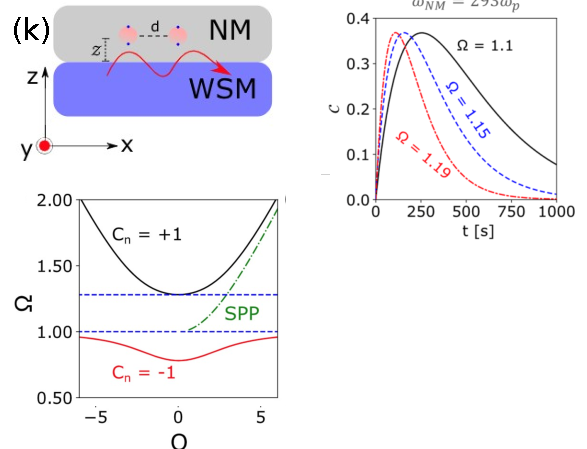
Figure 5: Topological Surface Waves for Qubit Entanglement. (k) Schematic of two qubits situated near the interface of a normal medium (NM) and a Weyl semimetal (WSM). Unidirectional surface plasmon polaritons (SPPs) with Chern number $C_n = \pm 1$ mediate long-lived quantum concurrence $\mathcal{C}(t)$ between the qubits [Phys. Rev. B 106, 155409 (2022)].
Future Research Program
Our ongoing research agenda targets the uncharted interface between quantum geometry, strong correlations, and quantum computing:
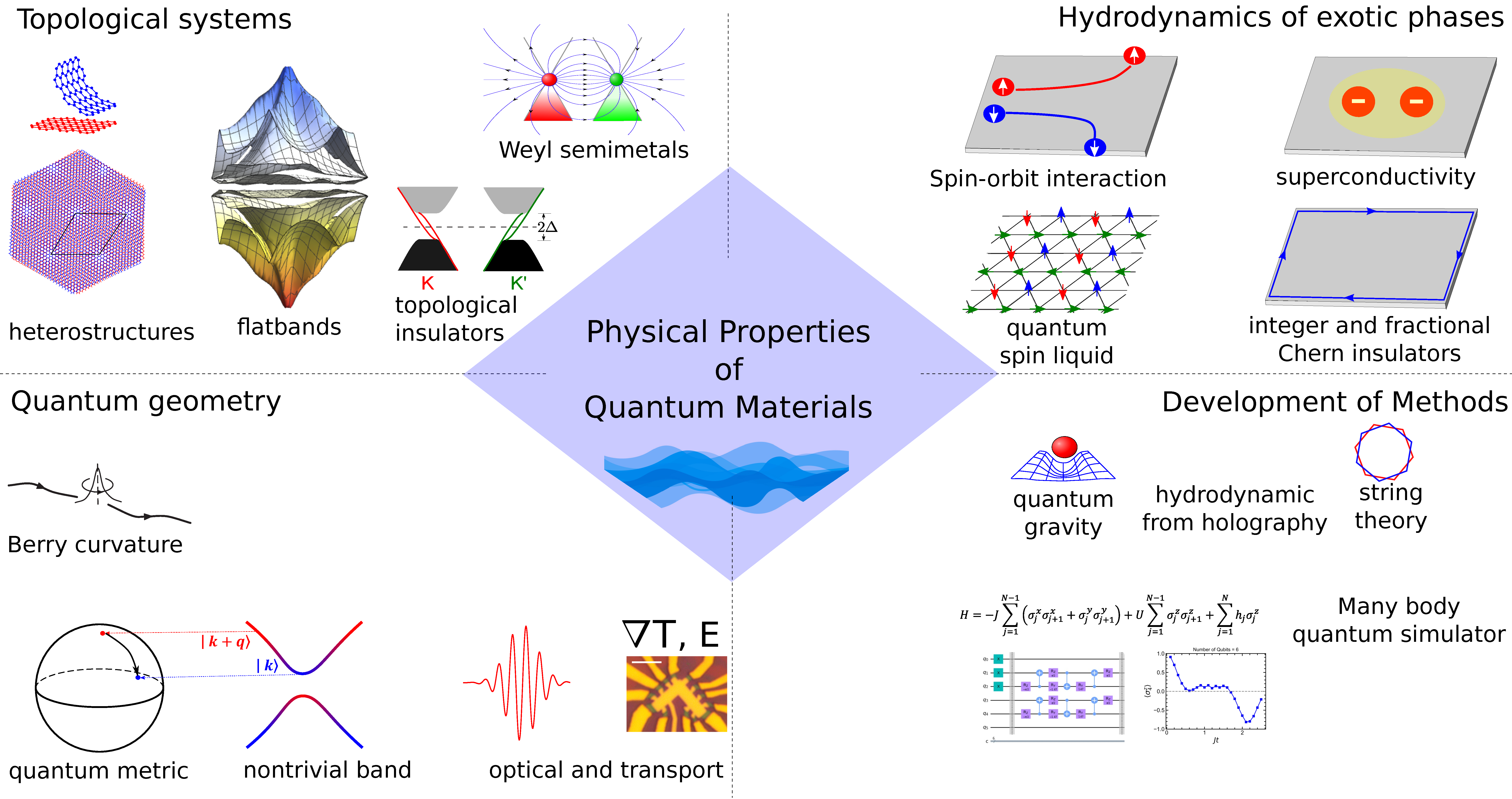
Figure 6: Research Vision & Methodology. [Topological Systems]: Moiré heterostructures (multilayer rhombohedral graphene on hBN) exhibiting flat bands and fractional anomalous Hall effects; Weyl semimetals with chiral anomaly dipoles; inverted-gap valley Hall states. [Quantum Geometry]: Unifying Berry curvature (self-rotating wave functions) and quantum metric (Bloch state distance) to predict novel non-linear optical and thermoelectric responses. [Hydrodynamics of Exotic Phases]: Extending hydrodynamic equations to spin-charge dynamics, non-abelian anyon excitations, fractional Chern insulators, and frustrated quantum spin liquids. [Method Development]: Integrating kinetic Boltzmann theory, holographic AdS/CFT correspondence for non-quasiparticle regimes, and quantum circuit simulations on quantum hardware.
1. Quantum Metric in Non-Linear Optoelectronics
While the Berry curvature governs linear transverse responses (such as the anomalous Hall effect), the quantum metric determines the spatial spread of electron wave packets and flat-band superconductivity. We are deriving non-perturbative non-linear optical, shift-current, and thermoelectric responses governed by quantum metric tensors.
2. Spin-Hydrodynamics & Fractional Phases
Investigating collective electron flows in moiré graphene superlattices hosting fractional quantum anomalous Hall states without magnetic fields. We are constructing hydrodynamic equations that incorporate spin-angular momentum conservation and non-abelian topological statistics.
3. Holographic AdS/CFT Transport
Developing hydrodynamic models for strongly correlated materials without well-defined quasiparticles (such as strange metals and high-$T_c$ cuprates) using gauge/gravity duality (AdS/CFT correspondence).
4. Quantum Simulation of Many-Body Physics
Employing quantum computing circuits and algorithms to benchmark and simulate non-equilibrium dynamics and correlated states that remain computationally intractable on classical architectures.